


Regular financial reporting is a critical aspect of managing a successful business. It provides essential insights into your company’s financial health and is a powerful tool for strategic planning and decision-making. Here’s why regular financial reporting is indispensable for business growth and how it aligns with the services provided by Tall Books.
Without consistent financial reporting, business owners may struggle to understand how their company is truly performing. Reliable financial data allows management to move beyond guesswork and base decisions on measurable results.
Understanding Regular Financial Reporting
Regular financial reporting involves generating consistent and timely financial statements, such as profit and loss statements, balance sheets, and cash flow statements. These reports offer a detailed view of your business’s financial performance over specific periods, enabling you to monitor progress and make informed decisions.
Together, these reports provide a structured overview of how revenue is generated, how expenses are managed, and how financial resources are distributed within the business.
Incorporating digital tools and platforms into financial reporting can enhance accuracy and efficiency. Cloud-based accounting solutions, for instance, allow real-time reporting and accessibility, enabling you to view and analyze financial data from anywhere at any time. This can significantly improve the speed and reliability of your financial reporting processes.
Benefits of Regular Financial Reporting
There are numerous benefits to maintaining regular financial reports:
-
- Enhanced Decision-Making: Access to up-to-date financial data allows business owners and managers to make informed investment decisions quickly. Whether it’s about expansion, capital allocation, or cost-cutting, timely financial information supports sound decision-making.
Integrating data visualization tools can further aid decision-making by providing clear, graphical representations of financial data. This helps in identifying trends and patterns more easily, facilitating quicker and more accurate data-driven decisions through variance analysis and risk assessment.
Regular reporting also ensures that decisions are based on current financial realities rather than outdated assumptions or incomplete information.
- Enhanced Decision-Making: Access to up-to-date financial data allows business owners and managers to make informed investment decisions quickly. Whether it’s about expansion, capital allocation, or cost-cutting, timely financial information supports sound decision-making.
-
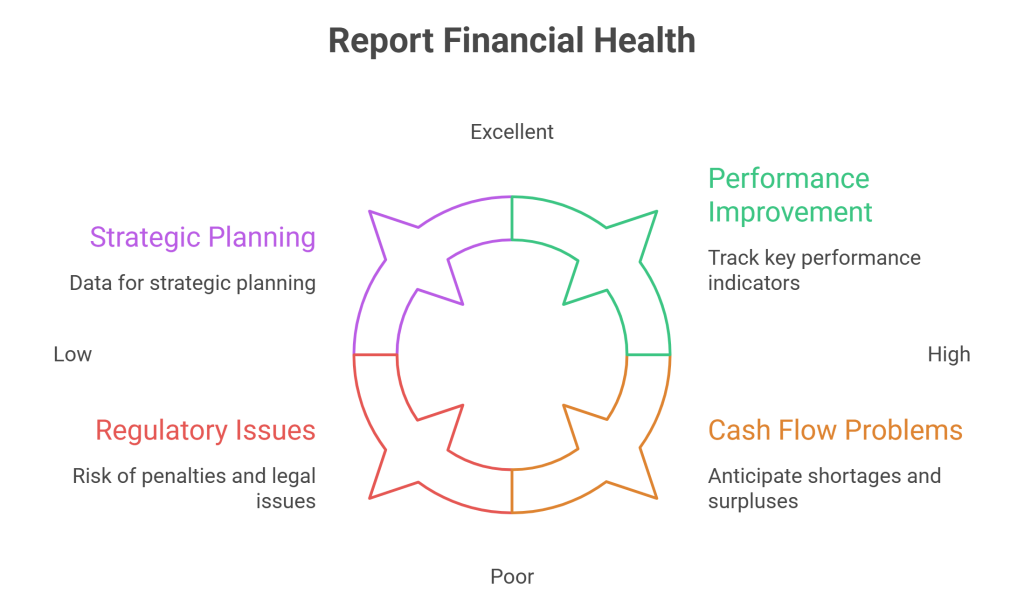
- Improved Business Performance Metrics: Regular reporting helps track key performance indicators (KPIs) such as revenue growth, profit margins, and return on investment (ROI). Monitoring these business performance metrics is crucial for identifying trends and areas for improvement.
Leveraging benchmarking tools can also help compare your business performance against industry standards, providing additional context and helping to set more realistic performance targets. Consistent monitoring of performance metrics enables businesses to evaluate whether strategies are delivering the expected financial results.
- Improved Business Performance Metrics: Regular reporting helps track key performance indicators (KPIs) such as revenue growth, profit margins, and return on investment (ROI). Monitoring these business performance metrics is crucial for identifying trends and areas for improvement.
-
- Better Cash Flow Management: Understanding your cash flow patterns through regular reporting helps you anticipate shortages and surpluses. This allows for better planning and ensures you have enough liquidity to meet your obligations.
Advanced cash flow forecasting tools can predict future cash flow needs based on historical data and projected sales, helping you plan for seasonal fluctuations and unexpected expenses more effectively. Monitoring accounts receivable, accounts payable, and working capital ensures optimal liquidity management.
Understanding your operating cash flow, free cash flow, and cash conversion cycle helps maintain a healthy cash runway while managing your burn rate effectively.
Effective cash flow monitoring is particularly important for small businesses, where even short-term liquidity challenges can affect operations.
- Better Cash Flow Management: Understanding your cash flow patterns through regular reporting helps you anticipate shortages and surpluses. This allows for better planning and ensures you have enough liquidity to meet your obligations.
-
- Informed Strategic Planning: Comprehensive financial analysis of regular reports provides the data needed for strategic planning. This can include budgeting, forecasting, and setting financial goals that align with your business growth objectives.
Financial modeling and sensitivity analysis tools can also be integrated into strategic planning to model different financial outcomes based on various business decisions, helping you prepare for potential risks and opportunities through effective contingency planning and risk assessment. Strategic planning becomes significantly more effective when supported by reliable financial reporting and historical performance data.
- Informed Strategic Planning: Comprehensive financial analysis of regular reports provides the data needed for strategic planning. This can include budgeting, forecasting, and setting financial goals that align with your business growth objectives.
-
- Regulatory Compliance: Regular financial reporting ensures that your business stays compliant with regulatory requirements, reducing the risk of penalties and legal issues.
Staying updated with changes in tax laws and accounting standards through professional services can further ensure compliance and prevent costly errors. Clear financial records also make it easier to respond to audits, regulatory reviews, or financial due diligence processes.
- Regulatory Compliance: Regular financial reporting ensures that your business stays compliant with regulatory requirements, reducing the risk of penalties and legal issues.
Driving Business Growth Through Financial Reporting
Financial reporting is not just about compliance; it’s a tool for driving business growth. Here’s how:
-
- Identifying Growth Opportunities: Detailed financial reports can reveal profitable areas of your business and highlight opportunities for growth. This could be expanding a successful product line, entering new markets, or increasing marketing efforts.
Implementing predictive analytics can enhance your ability to identify emerging market trends and customer preferences, allowing you to capitalize on new growth opportunities more proactively while optimizing your inventory management and expense tracking processes. By reviewing performance data regularly, businesses can identify which products, services, or operations generate the strongest returns.
- Identifying Growth Opportunities: Detailed financial reports can reveal profitable areas of your business and highlight opportunities for growth. This could be expanding a successful product line, entering new markets, or increasing marketing efforts.
-
- Optimising Resource Allocation: By understanding where your money is going, you can allocate resources more effectively. This might mean investing more in high-performing areas and cutting costs in underperforming ones.
Resource allocation tools and performance dashboards can help track the efficiency of your investments and operational expenditures, ensuring that resources are optimally distributed. Better resource allocation helps businesses maximise the value of every dollar spent.
- Optimising Resource Allocation: By understanding where your money is going, you can allocate resources more effectively. This might mean investing more in high-performing areas and cutting costs in underperforming ones.
-
- Improving Financial Health: Regular analysis of financial statements helps identify issues such as declining sales, rising costs, or cash flow problems early on. Addressing these issues promptly improves your business’s overall financial health.
Regular financial health checks and audits by external consultants can provide an additional layer of oversight, helping to identify and rectify financial discrepancies or inefficiencies that internal reports may miss. Early detection of financial challenges allows businesses to take corrective action before problems escalate - Building Investor Confidence: Consistent financial reporting builds transparency and trust with investors and lenders. It shows that your business is well-managed and financially stable, making it easier to secure funding for growth.
Creating detailed investor reports and presentations that highlight key financial metrics and growth strategies can further enhance investor confidence and attract potential funding. Reliable financial reporting demonstrates accountability and strengthens credibility with financial partners.
- Improving Financial Health: Regular analysis of financial statements helps identify issues such as declining sales, rising costs, or cash flow problems early on. Addressing these issues promptly improves your business’s overall financial health.
The Role of Bookkeeping in Financial Reporting
Accurate financial reporting depends on well-maintained bookkeeping records. Bookkeeping ensures that transactions are recorded correctly, reconciled regularly, and organised in a way that supports accurate financial reporting.
Without accurate bookkeeping, financial reports may contain errors that affect decision-making, performance analysis, and compliance with financial regulations.
Strategic Financial Reporting with Tall Books
At Tall Books, we understand the importance of strategic financial reporting for business growth. Our services are designed to provide you with accurate, timely, and comprehensive financial reports that support your business objectives. Here’s how we can help:
-
- Customised Reporting Solutions: We tailor our reporting services to meet the specific needs of your business, ensuring that you get the insights that matter most.
We also offer tailored financial dashboards and custom report generation to align with your unique business requirements and industry standards.
- Customised Reporting Solutions: We tailor our reporting services to meet the specific needs of your business, ensuring that you get the insights that matter most.
-
- Expert Analysis and Advice: Our team of financial experts analyses your reports and provides actionable advice to help you make informed decisions.
Our advisory services include strategic insights into financial trends, risk management strategies, and growth opportunities, ensuring that you are well-prepared for future challenges and opportunities.
- Expert Analysis and Advice: Our team of financial experts analyses your reports and provides actionable advice to help you make informed decisions.
-
- Advanced Reporting Tools: We use the latest accounting software and tools to generate accurate and detailed financial reports.
Our use of advanced reporting tools includes data integration and automation features that streamline reporting processes and enhance data accuracy.
- Advanced Reporting Tools: We use the latest accounting software and tools to generate accurate and detailed financial reports.
-
- Ongoing Support: We offer continuous support and updates, helping you stay on top of your financial health and adapt to changing circumstances.
Our ongoing support includes regular financial reviews and updates on regulatory changes, ensuring that your reporting remains relevant and compliant.
- Ongoing Support: We offer continuous support and updates, helping you stay on top of your financial health and adapt to changing circumstances.
Why Consistency in Financial Reporting Matters
Consistency in financial reporting ensures that financial data can be accurately compared over time. Regularly generated reports allow businesses to identify trends, measure growth, and detect potential issues before they impact operations.
Consistent reporting also strengthens internal financial management by ensuring that decision-makers always have access to reliable and up-to-date information.
Conclusion
Regular financial reporting is a cornerstone of effective business management. It provides the insights needed for informed decision-making, strategic planning, and driving business growth. By partnering with Tall Books, you can ensure that your financial reporting is accurate, comprehensive, and aligned with your growth objectives.
Let Tall Books assist you in leveraging the power of regular financial reporting to unlock your business’s full potential. Contact us today to learn more about our reporting services and how we can support your business growth.