


This article explains the differences between a balance sheet and an income statement, and shows how these core financial reports work together to help business owners understand performance, stability, and cash flow.
What you’ll learn:
- what a balance sheet shows and why it matters for financial stability
- how an income statement measures profitability over time
- the key differences between financial position and financial performance
- why cash flow statements are essential for day-to-day decision-making
- how changes in equity reflect reinvestment and shareholder value
- how financial ratios turn raw data into actionable insights
- why notes to the financial statements improve transparency
Understanding financial statements might sound daunting, but it’s crucial for small business owners to stay on top of their game. Each financial report offers unique insights into different aspects of your company’s health.
Financial statements don’t exist in isolation. Together, they form a complete picture of how your business is performing, where it stands financially, and how sustainable it is in the long run.
This listicle will break down the essentials of financial statement analysis, helping you make informed decisions and ultimately steer your business toward success.
1. Balance Sheet
What is it?
The balance sheet provides a snapshot of your company’s financial position at a specific point in time. It details what your business owns (assets), what it owes (liabilities), and the shareholders’ equity.
Because it reflects a single moment in time, the balance sheet is particularly useful for understanding financial structure rather than performance.
Why it matters
- Assessing net worth: By understanding your assets and liabilities, you can easily calculate your company’s net worth.
- Financial stability: The balance sheet helps you gauge whether your business is financially stable or if it’s relying too much on borrowed funds.
It also highlights how your business is financed through debt, equity, or retained earnings which can influence future funding and investment decisions.
Practical tip
Regularly review your balance sheet to make informed decisions about investing and financing to foster growth. For example, if you notice a high level of current liabilities compared to current assets, consider strategies to improve your working capital.
Bookkeepers in Australia, like our team at Tall Books, can provide invaluable insights into maintaining your financial stability and managing your accounts payable and accounts receivable effectively.
2. Income Statement
What is it?
Also known as the Profit and Loss Statement, an income statement outlines your company’s revenues and expenses over a specific period. It reveals whether your business is generating net income or incurring a loss.
Unlike the balance sheet, the income statement focuses on performance over time rather than a fixed point.
Why it matters
- Operational efficiency: By reviewing your income statement, you can identify how efficiently your business is operating.
- Profitability: It shows your ability to generate profit by increasing revenue or reducing costs.
This makes the income statement a critical tool for evaluating pricing strategies, cost control, and overall business sustainability.
Practical tip
Keep an eye on trends in net sales, operating income, and operating margin. For instance, if your operating expenses, including depreciation expense and interest expense, are consistently rising, it may be time to re-evaluate your cost management strategies.
Tall Books’ expert bookkeepers in Australia can help you analyze these trends and provide actionable advice to improve your gross margin and profit margin.
Balance Sheet vs Income Statement: Key Differences Explained
While both statements are essential, they answer very different financial questions.
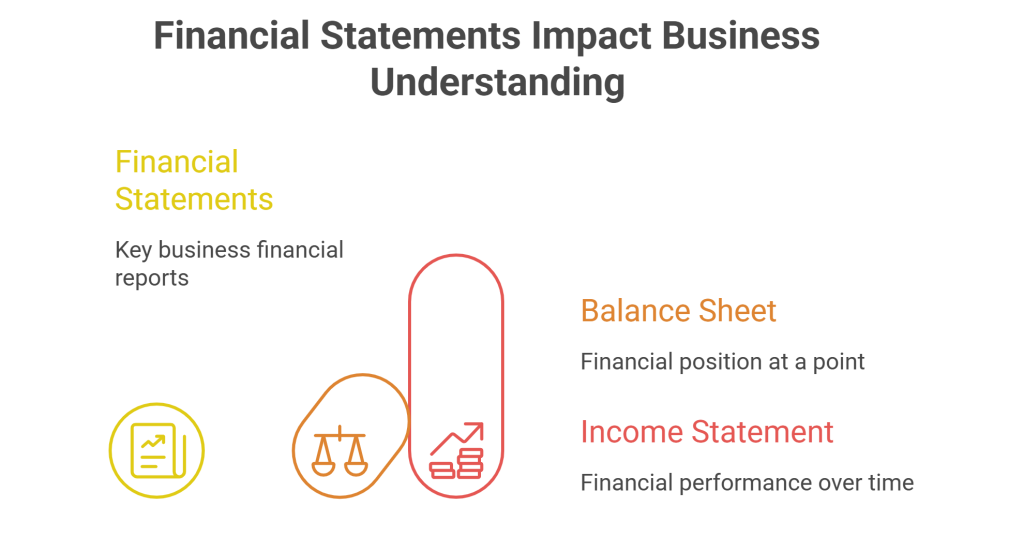
The balance sheet tells you what your business owns and owes at a specific moment, offering insight into financial position and stability. The income statement, on the other hand, shows how your business performed over a period of time by tracking income and expenses.
In simple terms, the balance sheet focuses on “where you stand,” while the income statement focuses on “how you performed.” Understanding both together allows business owners to connect profitability with financial strength.
3. Cash Flow Statement
What is it?
The cash flow statement details how cash enters and leaves your business. It is divided into three sections operating activities, investing activities, and financing activities showing how well your company manages its cash and free cash flow.
This statement bridges the gap between profitability and liquidity.
Why it matters
- Liquidity: It helps you understand your company’s ability to meet short-term obligations.
- Expense management: By tracking cash flows, you can make more informed decisions about spending and saving.
Even profitable businesses can struggle if cash flow is poorly managed, making this statement especially important for day-to-day operations.
Practical tip
Pay close attention to the cash flow from operating activities. If you’re consistently seeing negative cash flow, it’s a sign that you need to improve your operational efficiency or adjust pricing strategies.
The team of bookkeepers in Australia at Tall Books can assist in optimizing your cash flow management and analyzing your free cash flow.
4. Statement of Changes in Equity
What is it?
This lesser-known but important report details the changes in the shareholders’ equity section of your balance sheet over a specific period. It includes contributions from shareholders, common stock issuances, and retained earnings.
It explains why equity has increased or decreased between reporting periods.
Why it matters
- Investment decisions: Helps investors understand how their investments are performing.
- Retention strategy: Shows how profits are being reinvested into the business.
Practical Tip
Use this statement to communicate with potential investors. Highlight how you reinvest profits to fuel growth, showcasing your commitment to long-term success.
Tall Books, with their team of expert bookkeepers in Australia, can guide you in presenting this information effectively and explaining your approach to equity financing.
5. Financial Ratios
What are they?
Financial ratios are derived from your financial statements and provide deeper insights into your company’s performance. Key ratios include profitability ratios, liquidity ratios, efficiency ratios, and leverage ratios.
They transform raw financial data into meaningful performance indicators.
Why they matter
- Quick insights: Ratios offer a snapshot of your business health and financial performance.
- Benchmarking: Compare your ratios with industry standards to see how your business stacks up.
Practical tip
Calculate and monitor various financial ratios regularly:
- Inventory turnover ratio to assess your inventory management efficiency
- Current ratio (current assets divided by current liabilities) to assess your short-term financial health
- Asset turnover ratio to measure how efficiently your company uses its assets to generate revenue
- Return on equity (ROE) and return on assets (ROA) to evaluate profitability
- Inventory turnover ratio to assess your inventory management efficiency
The bookkeepers in Australia at Tall Books can help you interpret these ratios and apply them to your business strategy through comprehensive financial ratio analysis.
6. Notes to the Financial Statements
What are they?
These notes provide additional context, explaining the accounting principles used in preparing the financial statements and offering detailed breakdowns of certain items, such as intangible assets or goodwill.
They support the numbers shown in the main financial statements.
Why they matter
- Transparency: Enhances the transparency of your financial reporting.
- Clarity: Helps stakeholders understand the numbers better, leading to more informed decisions.
Practical tip
Ensure the notes are detailed and clear. Transparency builds trust with investors and other stakeholders, making them more likely to support your business.
Tall Books’ bookkeepers in Australia can assist in crafting comprehensive notes that highlight your business’s financial practices and explain complex items like financial leverage or preferred stock.
How These Statements Work Together
No single financial statement tells the full story. The balance sheet, income statement, and cash flow statement are interconnected and should always be reviewed together.
For example, strong profits on the income statement should eventually strengthen the balance sheet and improve cash flow. Reviewing them as a group helps identify inconsistencies and uncover deeper insights into business performance.
Finally
Understanding your financial statements is not just about compliance; it’s about gaining the insights needed to make strategic decisions. Whether it’s evaluating your net worth through the balance sheet, assessing profitability via the income statement, or managing liquidity with the cash flow statement, each report offers valuable information.
To get the most out of your financials, consider employing various analysis techniques:
- Horizontal analysis to compare financial data over time
- Vertical analysis to understand the relative proportions of different items
- Trend analysis to identify patterns in your financial performance
Want to take control of your financial health? If you need advice or assistance with financial statement analysis or ratio analysis, reach out to Tall Books. Our expert bookkeepers in Australia are here to help you navigate your financial statements, understand your earnings per share, and make well-informed business decisions to drive your company’s success.